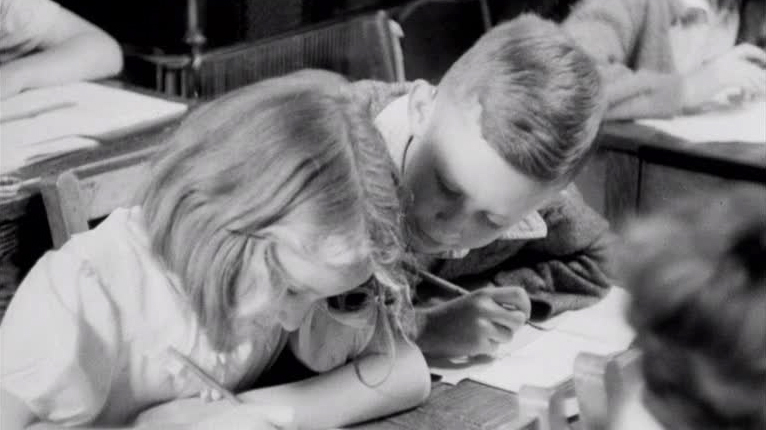
Children Talking 1 Assessing Spoken Language at Eleven
Developing talking and listening skills for 11 year olds.
The National Foundation for Educational Research is used as a setting for this 1985 training film for teachers and educational staff. The film aims to show ways of formally assessing how children use the spoken language in the learning process. A number of assessment exercises are shown as examples of good performance. The children are given tasks in which they must listen and relay information, explain to others, create narratives and summarise and discuss information they have read. The majority of the video acts as an observer of the children as they respond to the tasks, giving the viewer an almost real-time view of the activities. The minimal instructional narration puts the emphasis on the viewer making their own judgments on the performance of participants.
This video was produced by the Department of Education and Science as part of the Assessment of Performance Unit. It marked a movement towards standardisation of achievement at various stages in a child's educational development. This was further established by the 1988 Education Reform Act that included the introduction of 'Key Stages' which set educational targets for each age group.
How We Learned
From classroom to lecture hall to living room: a look at the many ways TV and video shaped our learning experiences over the years.
For most of us, the screen has been as much a part of our education as the blackboard or whiteboard. Early 20th century educators quickly saw that moving images could be a valuable teaching aid, and by the 1920s and 30s a thriving industry was delivering thousands of films for classroom use. By the 1960s, the small screen had largely taken over, and schoolkids would thrill at the sight of the teacher wheeling out a television set.
In the meantime, education was transforming, too, with grammar schools, secondary moderns and technical schools giving way to comprehensives, which in turn made room for academies and faith schools. Higher education swelled with new universities and polytechnics, while the Open University, launched in 1969, used video and television to reach students in their homes. Through television, informal learning has also helped those who missed out on traditional schooling, or who just want to expand their minds. Whether we spoke our first words along with onscreen puppets, studied along with Open University broadcasts or followed educational debates in current affairs programmes, television and video have always had a lot to teach us.
22 videos in this collection
Watch in libraries only
Watch in libraries only
Make It Count [22/01/78]
Watch in libraries only
Elton Well Dressing
Watch in libraries only
Bill Has Trouble with the Magic Box
Watch in libraries only
Don't Ask Me [10/08/77]
Watch in libraries only
School
Watch in libraries only
School Leaver
Watch in libraries only
Chalkface [04/07/82]
Adult Basic Skills: Entrance
Watch in libraries only
Think Tank [18/08/81]
Watch in libraries only
A New Choice of School
Watch in libraries only
Children Talking 1 Assessing Spoken Language at Eleven
Watch in libraries only
Teaching Science: Object Lessons
Watch in libraries only
Able Children
Watch in libraries only
Brighton Polytechnic Promo 2
Watch in libraries only
Painting by Numbers
Watch in libraries only
Multi-cultural Education
Watch in libraries only
One Week in July
Watch in libraries only
Introduction to Computers
Watch in libraries only
Christmas Special
Dulwich College and Village